
It's time we dispensed with the paper trail and shifted all labour law paper, workflows and permissions online.

'The US slump could hit our hosiery market hard since 40 per cent of our exports go there.' 'Job losses could be severe if the government doesn't step in fast.'

A BJP leader in Uttar Pradesh has sparked controversy by suggesting that Muslim men cover themselves with tarpaulins to avoid being sprinkled with colors on Holi. The remarks, made by Raghuraj Singh, come days after a police officer in Sambhal made similar comments. The festival of Holi coincides with the second Friday of the month of Ramzan this year, leading to concerns about potential clashes. The controversy has fueled tensions between Hindu and Muslim communities in the state, highlighting the sensitive nature of religious festivals in India.

Union Labour Minister Bhupender Yadav has exuded confidence that four labour codes, which would bring another wave of reforms, will soon be implemented as around 90 per cent of states have already come out with draft rules. In 2019 and 2020, 29 central labour laws were amalgamated, rationalised and simplified into four labour codes, viz, the Code on Wages, 2019; the Industrial Relations Code, 2020; the Code on Social Security, 2020; and the Occupational Safety, Health & Working Conditions Code, 2020, noted the Survey. During an interaction, Yadav told reporters that around 90 per cent of the states have already published draft rules on four labour codes and he expects the four legislations would become operational soon.
The four labour codes are unlikely to be implemented this fiscal in view of slow progress on the drafting of rules by the states and also for political reasons like elections in Uttar Pradesh, a source said. The implementation of these laws assumes significance because once these are implemented there would be reduction in take-home pay of employees and firms have to bear higher provident fund liability. "The ministry of labour is ready with the rules under the four labour codes. But the states have been slow in drafting and finalising those under new codes.

The scheme, which will be effective from July 1, 2019 would benefit 36 million employees and 1.28 million employers. The ESI Act applies to factories with 10 or more workers and provides for medical, cash, maternity, disability and dependent benefits to employees drawing a salary of up to Rs 21,000 per month.

After assuming power in 2014 with a full majority of its own, the BJP-led NDA government started an ambitious process of reforming labour laws in the form of codes aimed at making the framework less cumbersome with a variety of alterations. It had planned four codes each for industrial relations, wages, social security and welfare, and occupational safety, health and working conditions. To this end, 35 central labour laws were to be converted into four codes that would have had the virtue of streamlining labour relations. But none of the proposed code Bills could be converted into a law principally because neither trade unions nor industry representatives came on board. They hold the key to India's low-growth-high unemployment paradigm but the government may struggle to push them through this time as well. Somesh Jha explains why

The Supreme Court of India directed the government to establish a legal framework to protect domestic workers and address their exploitation.

Reaching out to the working class, especially in the unorganised sector, the government rolled out several measures in 2011, raising minimum daily wages, enlarging health insurance coverage and also notifying Majithia Wage Board recommendations for newspaper and news agency employees.

Geopolitical tensions, trade policy uncertainties, volatility in international commodity prices and financial market uncertainties pose considerable risks to India's economic growth in the coming year, the finance ministry cautioned on Wednesday. "Global trade continues to be affected by uncertainty in the policy environment... tariff-related developments in multiple countries have heightened trade-related risks, affecting investment and trade flows globally.

The Rural Development Ministry has been allocated Rs 1.88 lakh crore in the Union Budget for 2025-26, around 5.75 per cent more than the allocation in the previous budget.
The four labour codes will not come into effect from April 1 as states are yet to finalise the relevant rules, which means that there will be no change in take home pay of employees and provident fund liability of companies for now. Once the wages code comes into force, there will be significant changes in the way basic pay and provident fund of employees are calculated. The labour ministry had envisaged implementing the four codes on industrial relations, wages, social security and occupational health safety & working conditions from April 1, 2021. The ministry had even finalised the rules under the four codes.

In the past 10 years, over 500 PSB officers have died by suicide. When targets are overwhelming, senior management and customers are both impatient, and there is constant fear, not every banker has the resilience to survive and thrive, warns Tamal Bandyopadhyay.

'Efforts are on to make the data readily available so that it proves useful for policymakers.'

Total employment generated by nine select sectors stood at 3.10 crore in the July-September 2021 quarter, which is 2 lakh more than that of the April-June period, according to a quarterly employment survey by the labour ministry released on Monday. The quarterly employment survey (QES) report released by Union Labour Minister Bhupender Yadav said that total employment numbers in the nine select sectors were 3.08 crore in April-June 2021.
Ushering in a big wave of reforms by implementing the four labour codes, setting up the national social security fund to cover over 38 crore informal sector workers and improving the ease of doing business will top the agenda of the labour ministry in the New Year. In a major move, the ministry launched the e-Shram portal on August 26, 2021 for creating a national database of over 38 crore informal sector workers. It will help the government to ensure last-mile delivery of benefits of various social security schemes to the informal-sector workers.

The next Census' findings will help identify the extent of India's ageing population and vulnerability levels.
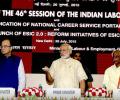
Calling the Budget 2018 'anti-labour', the Bharatiya Mazdoor Sangh will observe February 20 as a 'black day'.

'Not only jobs are not being generated, but people are also losing jobs.'

There is no doubt that archaic labour laws governing employment of contract labour have fanned tensions at the workplace and need to be amended.

The NHRC has observed that the content of the news report, if true, raise a serious issue of human rights of the workers in violation of the labour laws and the guidelines issued by the Union Ministry of Labour and Employment from time to time.

The norms, say industry experts, are not sufficient to weed out fly-by-night contractors.

As per the recommendations of the 2nd National Commission on Labour, the ministry is codifying existing 44 central labour laws into four codes by simplifying, amalgamating and rationalising the relevant provisions of the legislations.

IT services company Infosys on Wednesday said it did not use force or intimidation tactics when it laid off trainees at Mysuru campus over performance-related issues, and that it was explaining the circumstances to the labour department authorities. In an interview to PTI, Shaji Mathew, chief human resources officer at Infosys, however, conceded that assessment failure percentages this time around have been "slightly higher" than in the past but dismissed charges that the tests had been designed for failure.

Enforcement Directorate officials said on Friday they are probing a 'complex network' of agents and facilitators in India, Canada and the US who help Indians illegally enter the US via 'bogus' admissions in Canadian colleges.

Retirement fund body EPFO recorded a net addition of 19.94 lakh members in July this year, the labour ministry said on Monday. Union Labour Minister Mansukh Mandaviya said at a press conference that 10.52 lakh new or first-time workers subscribed to social security schemes run by Employees' Provident Fund Organisation (EPFO). The minister said almost 20 lakh net new members addition (19.94 lakh) was recorded in July this year.

After complaints that the new law may impact employment of women, the government has framed a scheme to provide monetary incentive to companies, reports Somesh Jha.

Finance Minister Nirmala Sitharaman on Saturday said the government will arrange identity cards and registration on the e-Shram portal to assist 1 crore gig workers. Presenting the Union Budget 2025-26, the finance minister also said a scheme for the socio-economic upliftment of urban workers will be implemented.

'This year overall hiring has seen a slight improvement as compared to the dip seen during the last financial year.'

Labour sector needs bigger reform than the PM revealed.

Following the lacklustre growth numbers in the second quarter (Q2FY25), economists believe the upcoming Union Budget for 2025-26 should focus on reforms that will stimulate consumption, manufacturing and spur employment. India's growth unexpectedly slowed to 5.4 per cent in the second quarter, due to low capital formation, weak consumption, besides adverse weather impact.
Employment in nine selected sectors, including construction, manufacturing and IT/BPO, was at 3.08 crore in the April-June quarter of 2021-22, reflecting a growth of 29 per cent compared to 2.37 crore reported in the Economic Census of 2013-14, according to a survey. Labour and Employment Minister Bhupender Yadav on Monday released the report of Quarterly Employment Survey (QES) part (April to June 2021), of the All-India Quarterly Establishment-based Employment Survey (AQEES) prepared by the Labour Bureau. Announcing the results, Yadav said the estimated total employment in the nine selected sectors from the first round of QES is 3 crore and 8 lakh approximately against a total of 2 crore and 37 lakhs in these sectors taken collectively, as reported in the sixth Economic Census (EC 2013-14) reflecting a growth rate of 29 per cent.

The implementation of four labour codes in one go from April 1 next year will usher in a new wave of reforms in industrial relations and also help in attracting more investments but employment generation will remain a key challenge in 2021. This year has also been a challenging year for the work force as well as for employers due to the outbreak of the COVID-19 pandemic. The government imposed a nationwide lockdown from March 25, which had an adverse impact on economic activities and resulted in exodus of migrant workers from large cities to their homes in the hinterland. Many migrant labourers lost their jobs and it took months for them to return back to their work places from their native places.
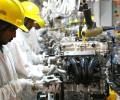
Single registration will be coupled with single licence, along with a single return, for executing projects for five years.
Their implementation is expected to create investment owing to improving ease of doing business as well as initiating pro-worker measures.
ILO acts upon a plea by 10 central trade unions objecting to the ordinances proposed to temporarily scrap labour laws in Uttar Pradesh and Gujarat, along with executive orders issued by at least 10 states to increase the daily working limit to 12 hours from eight hours, along with other labour law changes.

The Ministry of Electronics and Information Technology (Meity) is looking at a proposal to generate 1.5-2 direct jobs for every Rs 1 crore invested by companies under the proposed electronic components production-linked incentive (PLI) scheme. If this plan fructifies, a Rs 10,000 crore investment under the proposed PLI scheme would bring with it the expectation of creating 15,000-20,000 direct jobs in electronic components sector.

'This agreement will help the Indian workforce to move to non-traditional sectors of employment like teaching, nursing, and manufacturing.'

Retirement fund body EPFO has registered 13.41 lakh net new members addition in October 2024, according to showed latest payroll data. This signifies increased employment opportunities and heightened awareness of employee benefits, bolstered by EPFO's effective outreach initiatives, a labour ministry statement said on Wednesday.

The Ministry of Labour & Employment is investigating alleged "unsafe and exploitative work environment" days after the tragic demise of Anna Sebastian Perayil who worked with S R Batliboi, a member firm of EY Global. Perayil was a 26-year-old chartered accountant (CA) who died allegedly due to extreme work pressure at the firm. "Deeply saddened by the tragic loss of Anna Sebastian Perayil.
